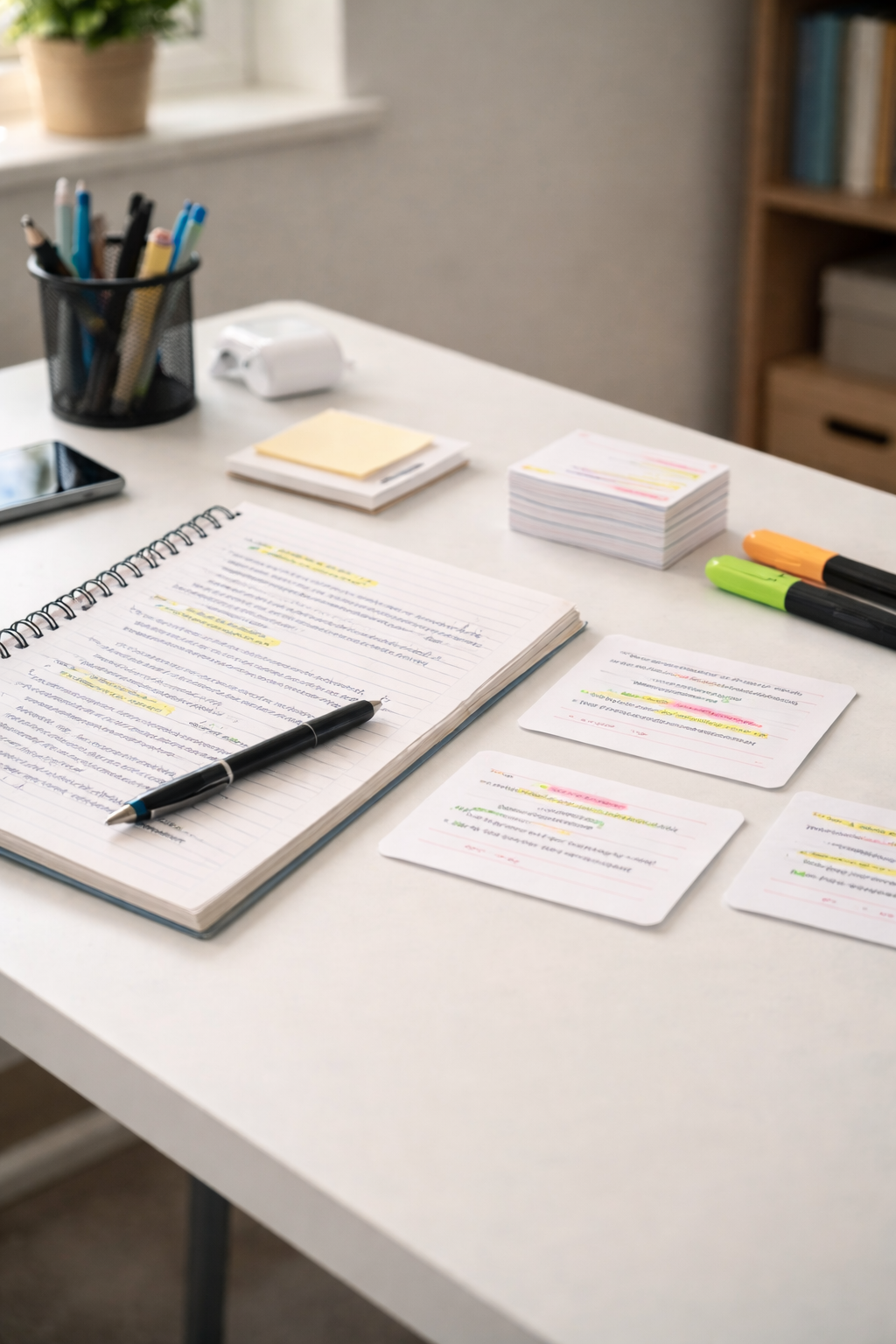
Most students don’t fail because they study too little, they fail because their study system isn’t built to work. You can have hundreds of flashcards and still feel unprepared if those cards aren’t structured the right way. A “perfect” flashcard deck isn’t about quantity, it’s about how well it helps you think.
The Problem: Why Most Flashcard Decks Fall Apart
If you’ve ever made your own deck, you’ve probably run into one of these issues:
- Too many cards, no organization
- Cards that are too vague or too detailed
- Repeating easy material while ignoring weak areas
But There is a Hidden Issue
Spending more time making cards than actually studying
It starts off productive. You feel like you’re building something useful, but over time, the deck becomes cluttered, inconsistent, and hard to review. That’s when flashcards stop being helpful and start becoming overwhelming.
The real issue isn’t the idea of flashcards, it’s the system behind them.
What Makes a “Perfect” Flashcard Deck?
A strong flashcard deck does three things well:
- It isolates key concepts
- It forces active recall
- It stays manageable over time
That means each card should focus on one idea, be easy to test, and fit into a larger structure you can actually keep up with. Think of your deck like a map. If it’s organized, you can move through it efficiently. If it’s messy, you waste time figuring out where to go next.
The goal isn’t to capture everything. It’s to capture what matters, and make it easy to review.
How to Build the Perfect Flashcard Deck (Step-by-Step)
Here’s a system you can follow that keeps your deck clean, effective, and easy to maintain.
Step 1: Start With Source Material, Not Memory
Don’t try to build your deck purely from what you remember. Use lectures, notes, or textbooks as your base. Your goal here is accuracy and coverage, not perfection.
Focus on identifying high-yield concepts:
- Definitions
- Processes
- Cause-and-effect relationships
- Comparisons
If it’s something you’d expect to be tested on, it belongs in your deck.
Step 2: Break Everything Into Small, Testable Units
One of the biggest mistakes is putting too much into a single card:
Instead of: “What are the steps of glycolysis?”
Break it into:
- “What is the first step of glycolysis?”
- “What enzyme is used in step 2?”
- “What is the final product of glycolysis?”
Smaller cards feel repetitive, but they dramatically improve recall speed and accuracy.
Step 3: Organize by Topic, Not by Time
Don’t just dump all your cards into one large deck.
Group them by subject or system:
- Cardiology
- Renal
- Metabolism
This makes it easier to target weak areas and review strategically instead of randomly.
Step 4: Review Early, Then Adjust
Don’t wait until your deck is “finished” to start reviewing. Begin as soon as you have a small set of cards.
As you review, you’ll notice which cards are unclear, which ones are too easy, and which concepts you keep missing. They refine your deck as you go. The best decks evolve over time.
Step 5: Keep It Lean
More cards doesn’t mean better results. If something is obvious or rarely tested, consider leaving it out. A smaller, high-quality deck will outperform a massive, unfocused one every time.
Think quality over quantity.
Where CardifyAI Fits Into This System
Building a deck like this manually takes time, and that’s where most students fall off. It’s not that they don’t understand how to do it, it’s that the process is slow, and consistency becomes difficult.
This is where CardifyAI can make a difference.
Instead of starting from scratch, you can take your source material and quickly generate structured flashcards that already follow many of these principles: clear questions, focused concepts, and active recall built in.
That doesn’t mean you skip thinking altogether. You still refine, organize, and review. But you’re not spending hours just trying to create the deck. It turns the process from “build everything yourself” into “optimize what’s already there.”
And that shift saves time, especially when your workload starts to pile up.
Build the System That Works Best For You
The perfect flashcard deck isn’t about perfection. It’s about consistency. If your deck is clear, focused, and easy to review, you’ll use it more, and that’s what leads to results.
Most students don’t need more study time, they need a better system.
If you build your deck around active recall, keep it organized, and refine it over time, you’ll notice something quickly: studying becomes more efficient, and information starts to stick.
That’s when flashcards stop feeling like work and start working for you.