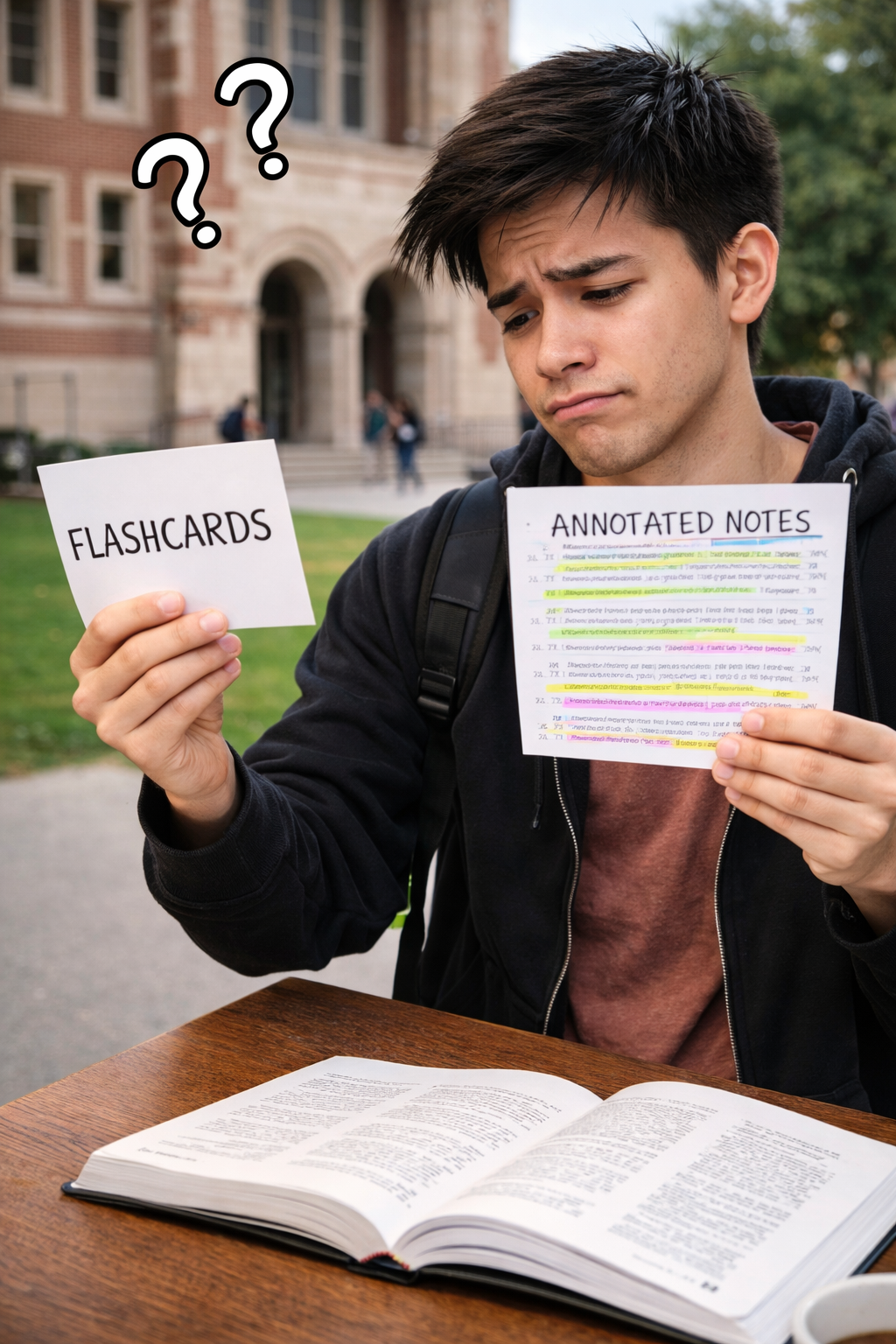
You can spend countless hours studying and still feel like you learned nothing. Meanwhile, someone else studies for half the time and walks into the exam confident. That gap usually isn’t about intelligence, it’s about technique. Most students aren’t taught how to study effectively. They just repeat what’s always felt “right,” even if it doesn’t actually work.
The Problem: Why Most Study Methods Fail
If your go-to strategy is rereading notes, highlighting everything, or watching lectures on repeat, you’re not alone. Those methods are popular because they’re easy. They feel productive, but they don’t force your brain to actually learn. The issue comes down to one thing: effort, but not effort you are lacking.
Passive techniques let you stay comfortable. You’re seeing information, not struggling with it. And that’s exactly why it doesn’t stick. Ever notice how something looks familiar when you review it, but disappears the second you’re tested on it? That’s passive learning in action. You recognize it, but you can’t recall it. Real learning requires a different approach. One that feels harder in the moment but saves you time in the long run.
Best Study Techniques That Actually Work
The most effective study techniques all share one thing in common: they force your brain to actively engage with the material. Here are the ones that consistently work across different subjects:
Active Recall
This is the foundation of effective studying. Instead of rereading, you’re testing yourself. You close your notes and try to bring the information to mind. That might look like answering questions, using flashcards, or explaining a concept out loud. It’s uncomfortable at first because you’ll realize what you don’t know. But that’s the point. Every time you struggle to recall something, you strengthen your memory.
A quick example:
Reading a page 3 times feels smooth but leads to weak retention. Trying to recall that same page from memory once is harder, but is far more effective.
Spaced Repetition
Cramming might get you through a quiz, but it won’t help you retain information long-term. Spaced repetition solves that by spreading your review sessions over time. Instead of studying something once, you revisit it just as you’re about to forget it. This timing matters. It strengthens memory at the exact moment it starts to fade. Even simple spacing by reviewing material the next day, then a few days later can dramatically improve retention.
Interleaving
Most people study one topic at a time in big blocks. It feels organized, but it can actually hurt learning. Interleaving mixes different topics or problem types together. Instead of doing 20 similar problems in a row, you alternate between types. Why does this work? It forces your brain to identify patterns and choose the right approach, rather than going on autopilot.
Practice Testing
This goes beyond just flashcards. Practice tests simulate the real experience of retrieving and applying knowledge under pressure. Even informal testing, like writing out everything you remember or answering your own questions, can have a huge impact. It’s one of the fastest ways to identify weak spots and fix them early.
Techniques to Avoid (Or Use Sparingly). Not all study methods are useless, but some are heavily overrated when used alone.
These are What You Should be Careful With
Rereading Notes
It feels productive because it’s familiar. But it’s one of the least effective ways to retain information. Use it as a quick review, not your main strategy.
Highlighting Everything
Highlighting can help you identify key points, but it doesn’t create understanding. If everything is highlighted, nothing stands out. If you do use highlighting, keep it minimal and pair it with active recall.
Watching Lectures Passively
Rewatching content without engaging with it leads to low retention. It’s easy to zone out and assume you’re learning. Instead, pause and test yourself on what was just covered. The key takeaway here isn’t to completely eliminate these methods, it’s to stop relying on them as your primary way of studying.
How to Actually Apply The Beneficial Techniques
Knowing what works is one thing. Using it consistently is another.
Here’s a simple system you can follow:
-
Start with a quick overview: Skim your material to understand the big picture. Don’t spend too long here.
-
Convert information into questions: Turn headings and key points into questions you can test yourself on.
-
Use active recall immediately: Close your notes and try to answer those questions without looking.
-
Review only what you missed: Focus your time on weak areas instead of repeating what you already know.
-
Space your sessions: Come back to the same material over time instead of cramming everything at once.
This approach keeps your study sessions efficient and focused. You’re not just putting in time, you’re actively training your brain to understand the material.
Where CardifyAI Fits Into This
One of the biggest challenges with effective study techniques is the setup. Turning notes into questions, organizing them, and reviewing them consistently takes effort. That’s often where students fall back into passive habits.
Tools like CardifyAI are built around solving that exact problem. Instead of manually creating flashcards or practice questions, you can take your existing material and turn it into structured, recall-based content much faster. It doesn’t replace the need to think. It just removes the friction that slows you down.
When your study system is centered around active recall and spaced repetition, it becomes much easier to stay consistent, and consistency is what actually drives results.
Study Smarter, Not Longer
There’s a reason some students seem to learn faster without studying more. They’re using better strategies. The best study techniques that actually work aren’t complicated, they’re just different from what most people default to.
If you shift from passive review to active engagement by testing yourself, spacing your practice, and focusing on weak areas, you’ll start seeing results much faster.
At the end of the day, studying isn’t about how much time you spend. It’s about how you use that time.
Make it count.